August 21, 2007
Library in a Nutshell
When you
look at something like this (a 1965 miniature library), you get a sense of how far technology has gone (and might still go). I routinely carry around several hundred books and stories with me on a storage card the fraction of the size of this gadet.
Why stop at some books? Why not the universe in a library?
more...
Posted by: Fred Kiesche at
07:18 AM
| No Comments
| Add Comment
Post contains 85 words, total size 1 kb.
One Solution to "Climate Change"
Change the planet! However, I would suggest an even better solution would be to
re-engineer our entire Solar System. If that's no good, what about
a disk, or
a ring, or even
cosmic spaghetti?
Don't go backwards. Leap forwards.
Posted by: Fred Kiesche at
07:06 AM
| Comments (2)
| Add Comment
Post contains 49 words, total size 1 kb.
1
Some links for you:
http://www.metatronics.net/lit/geo2.html
http://www.ucalgary.ca/~keith/papers/26.Keith.2000.GeoengineeringHistoryandProspect.e.pdf
Posted by: Ron Fischer at August 21, 2007 11:59 AM (b993W)
2
I think I even came across a sun shield idea. Probably wouldn't be practical unless we had a space elevator first to launch the materials or the industry we'd need to make the materials out of asteroids, etc., first.
Posted by: P*l*anet Stories at August 21, 2007 01:13 PM (jc70B)
Hide Comments
| Add Comment
August 19, 2007
August 18, 2007
The Cargo Cult of Science
But there is one feature I notice that is generally missing in cargo cult science. That is the idea that we all hope you have learned in studying science in school—we never say explicitly what this is, but just hope that you catch on by all the examples of scientific investigation. It is interesting, therefore, to bring it out now and speak of it explicitly. It's a kind of scientific integrity, a principle of scientific thought that corresponds to a kind of utter honesty—a kind of leaning over backwards. For example, if you're doing an experiment, you should report everything that you think might make it invalid—not only what you think is right about it: other causes that could possibly explain your results; and things you thought of that you've eliminated by some other experiment, and how they worked—to make sure the other fellow can tell they have been eliminated.
Details that could throw doubt on your interpretation must be given, if you know them. You must do the best you can—if you know anything at all wrong, or possibly wrong—to explain it. If you make a theory, for example, and advertise it, or put it out, then you must also put down all the facts that disagree with it, as well as those that agree with it. There is also a more subtle problem. When you have put a lot of ideas together to make an elaborate theory, you want to make sure, when explaining what it fits, that those things it fits are not just the things that gave you the idea for the theory; but that the finished theory makes something else come out right, in addition.
In summary, the idea is to give all of the information to help others to judge the value of your contribution; not just the information that leads to judgment in one particular direction or another.
(Richard Feynman, Ph.D.)
Posted by: Fred Kiesche at
06:57 PM
| No Comments
| Add Comment
Post contains 328 words, total size 2 kb.
August 12, 2007
Heretic
One of the
smartest guys I know is coming out with
a new book! And...
in this essay...he has some interesting things to say about "climate change".
My first heresy says that all the fuss about global warming is grossly exaggerated. Here I am opposing the holy brotherhood of climate model experts and the crowd of deluded citizens who believe the numbers predicted by the computer models. Of course, they say, I have no degree in meteorology and I am therefore not qualified to speak. But I have studied the climate models and I know what they can do. The models solve the equations of fluid dynamics, and they do a very good job of describing the fluid motions of the atmosphere and the oceans. They do a very poor job of describing the clouds, the dust, the chemistry and the biology of fields and farms and forests. They do not begin to describe the real world that we live in. The real world is muddy and messy and full of things that we do not yet understand. It is much easier for a scientist to sit in an air-conditioned building and run computer models, than to put on winter clothes and measure what is really happening outside in the swamps and the clouds. That is why the climate model experts end up believing their own models.
more...
Posted by: Fred Kiesche at
07:17 AM
| Comments (2)
| Add Comment
Post contains 271 words, total size 2 kb.
1
In the community of climate change modelling all are welcome to join the fun, however, no one, not even the venerated Freeman Dyson, gets a free lunch. If he truly believes what he claims, then honesty demands he back it up with some kind of analysis or research. That's how science works, claims of heresy notwithstanding. Someone with his stature should be able to whistle up a group of grad students to put muscle behind a claim like this... shouldn't he? Regardless of the outcome we'll all learn something and THAT is the point after all.
Posted by: Ron Fischer at August 12, 2007 10:30 PM (jsh3+)
2
My (trying real hard to be non-political) thoughts...
(1) Climate change is less "science" than "politics". Neutrality is not found here. It's more like a debate on religion at times.
(2) Are humans changing the Earth's climate? Yes. But...
(3) The Earth's cliimate changes all the time. Look back over geological time...is what we have had the last several decades "normal"?
(4) If we are having an impact, how can we lessen or reverse the impact? I think that many simple things are being ignored.
(5) Even if we stop everything, the climate will still change. We need to be able to adapt to ride out changes that are adverse to us.
(6) Too many eggs in one basket. Yet another reason to find a way offworld.
Posted by: Nameless Blog Poster at August 12, 2007 10:34 PM (tOSLV)
Hide Comments
| Add Comment
August 09, 2007
The Little Things We're Losing
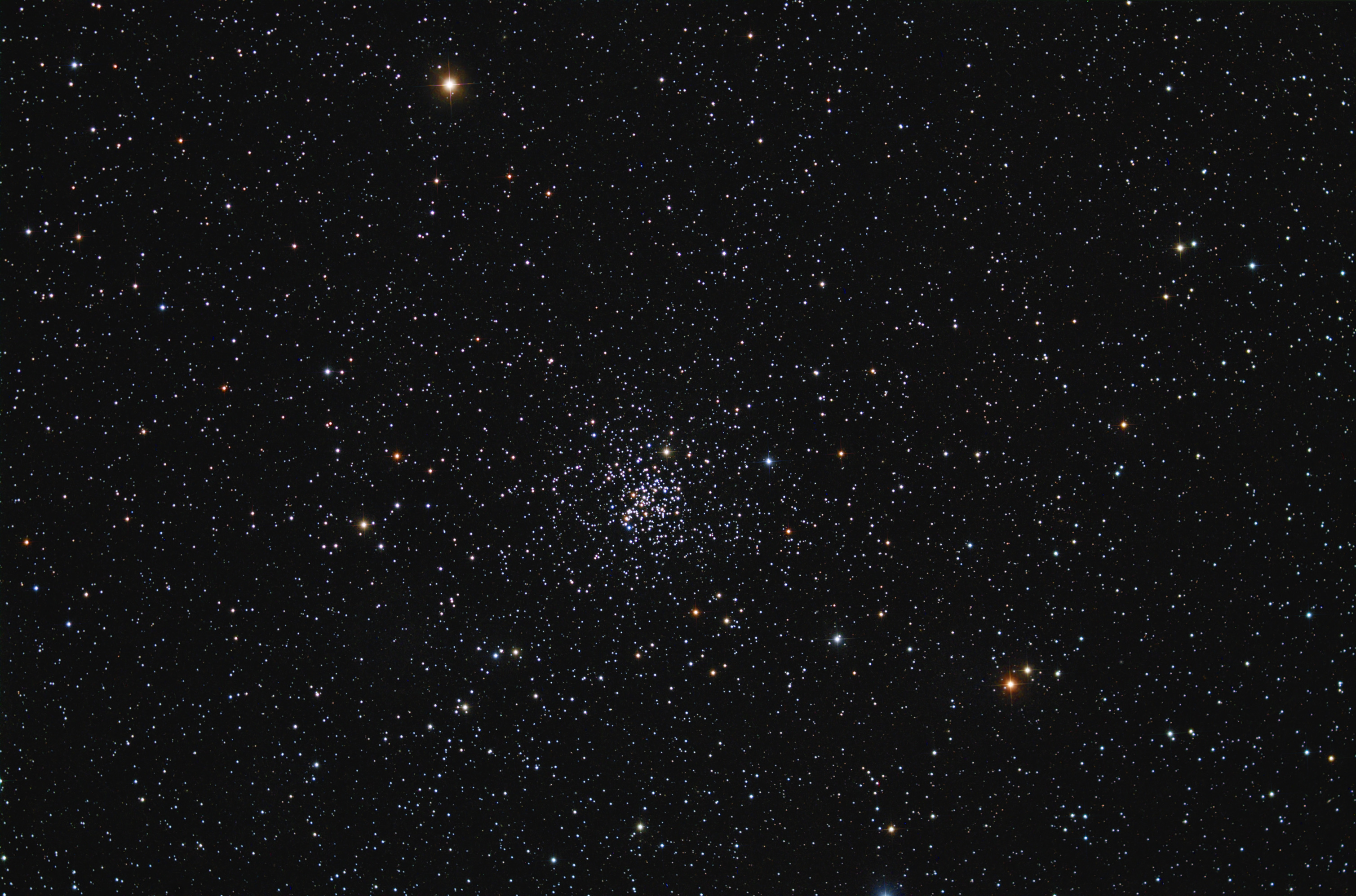
Like this. Once upon a time (when I was in college), I could go to a back road around the campus and see the Milky Way. When we got our house, I could still see the Milky Way. Then it was only during the dead of winter, or after the air had been cleared out, etc. Now it is a rare occasion when our increasingly urbanized skies allow me to see
sights like this with one of my telescopes, let alone my naked eyes.
Posted by: Fred Kiesche at
07:59 PM
| No Comments
| Add Comment
Post contains 94 words, total size 1 kb.
24kb generated in CPU 0.0253, elapsed 0.088 seconds.
58 queries taking 0.073 seconds, 135 records returned.
Powered by Minx 1.1.6c-pink.