



February 21, 2005
While repetitive, I actually enjoy Philip Glass.
While repetitive, I actually enjoy Philip Glass.
While repetitive, I actually enjoy Philip Glass.
While repetitive, I actually enjoy Philip Glass.
While repetitive, I enjoy Philip Glass' music. And it evolves.
While repetitive, I enjoy Philip Glass' music. And it evolves.
While repetitive, I enjoy Philip Glass' music. And it evolves.
While repetitive, I enjoy Philip Glass' music. And it evolves.
It's tonal, while repetitive, and it evolves, so I enjoy Philip Glass' music.
It's tonal, while repetitive, and it evolves, so I enjoy Philip Glass' music.
It's tonal, while repetitive, and it evolves, so I enjoy Philip Glass' music.
It's tonal, while repetitive, and it evolves, so I enjoy Philip Glass' music.
etc.
I first encountered Glass in his soundtrack to the visually stimulating Koyaanisqatsi. Glass is a polarizing figure, as I later discovered while a music student at UT Austin. I went to see him in concert (on solo piano). Before the concert, the theory-comp majors all slammed him as a gimmicky composer with no real talent (as though their atonal screeches were superior, somehow). Then, at the concert, were the rich and snobby non-musician hangers-on who pretended to have their moments of greatness, some even air-kissing (I'm serious!) when they met him. Gag.
When I met him briefly, he was friendly, warm, and quite unassuming. So I won't judge him too harshly as a person. As a composer, he made tonal music popular again, even if in the context of minimalism. One CD that I play about every three months to clear my mind is Passages (with Ravi Shankar). Hypnotic, lovely melodies that repeat, develop, intertwine, and resolve themselves. Music at its simple -- minimalist -- best.
Posted by: JohnL at
10:51 PM
| Comments (6)
| Add Comment
Post contains 323 words, total size 2 kb.
February 11, 2005
I've excerpted part of his New York Times obituary in the extended entry.
more...
Posted by: JohnL at
08:54 PM
| Comments (1)
| Add Comment
Post contains 706 words, total size 4 kb.
February 04, 2005
Yours truly submitted a list of ten, and Norm was gracious enough to post a link back to me with his results.
Go check out his list, topped by "(I Can't Get No) Satisfaction" by the Rolling Stones. I can't really argue that the top 10 belong there any more than mine did, although I have to say that my list attempted to identify "non-standard" standards.
Only 2 of mine even made his top "not-quite-100": #17 - A Day in the Life (Beatles) and #61, Nights in White Satin (Moody Blues).
Go check out the whole thing.
Posted by: JohnL at
09:53 PM
| No Comments
| Add Comment
Post contains 118 words, total size 1 kb.
February 03, 2005
Random Ten
Let's see -- first, open iTunes. Next, hit "shuffle" in the "Library" playlist. Hit Play. Write down song info. Hit Next. Repeat. Etc. Voila:
- Peter Gabriel, "Gethsemane," Passion: Music For The Last Temptation of Christ
- D Tent Boys, "Dig It" (Full Version), Holes [Soundtrack]
- Okui Masumi, "Shuffle," Devotion [Import]
- "O Little Town of Bethlehem" (Transferred to hard drive from vinyl Readers Digest's collection of Joyous Music For Christmas Time)
- Fear Factory with Gary Numan, "Cars," Obsolete
- Eagles, "Seven Bridges Road (Live)," Very Best of the Eagles
- AC/DC, "Hells Bells," Back in Black
- Bobby Vinton, "I Love How You Love Me," All-Time Greatest Hits
- Dire Straits, "Money For Nothing," Brothers in Arms
- Peter Gabriel, "Games Without Frontiers (Remix)," Steam [CD-single]
1. What is the total amount of music files on your computer?
Somewhere between 4 and 5 GBs at last count.
2. The last CD you bought is:
Presto, by Rush, about two weeks ago.
3. What is the song you last listened to before this message?
Led Zeppelin's Immigrant Song (on the radio on the drive home from work)
4. Five songs you often listen to or that mean a lot to you.
Rob broke the rules here by listing five nice classical pieces. None of them were really "songs." As you can tell from the random list above, my tastes are incredibly varied, so I've chosen five that mean a lot to me, and not all are "pop" songs:
- It Had to Be You, as performed by Harry Connick on When Harry Met Sally (the song I played when I proposed to my wife)
- Free Will, Rush, Hemispheres (A great statement of my philosophy and sense of life. Excerpt: "Each of us a cell of awareness, imperfect and incomplete. Genetic blends with uncertain ends, on a fortune hunt that's far too fleet...")
- Fanfare for the Common Man, Copland, as performed by Emerson, Lake, and Palmer (this is the song whose video inspired me to teach myself keyboards again in 1983).
- Battle Hymn of the Republic, Wilhousky arrangement (This song is as much fun to listen to as to sing. I am a multiple-generation Texan, but I never saw the charm of Dixie -- the Battle Hymn, on the other hand, has been a favorite of mine as long as I can remember).
- America The Beautiful (I've long thought this a more appropriate National Anthem than "O Say Can You See..." I like any version, but Ray Charles sure did a great one).
5. Who are you gonna pass this stick to (five persons and why)?
Nobody. I waited too long and many of the five I would forward this to have already done it. Please feel free to do it yourself, though, and trackback here.
Posted by: JohnL at
09:43 PM
| Comments (2)
| Add Comment
Post contains 480 words, total size 5 kb.
February 02, 2005
The video and audio are virtually seamless, an inspired combo of a couple of treacly 60s pop songs.
Posted by: JohnL at
09:43 PM
| No Comments
| Add Comment
Post contains 50 words, total size 1 kb.
January 19, 2005
I'm not a huge fan of Wagner, but the Goethe Institute has prepared an interactive multimedia site covering his Ring of the Niebelungen. While aimed at youth, the site is quite rewarding (and presented in German or English).
I paged through some of the comic strip version in German and found it quite entertaining and interesting. This would definitely be a great resource for anyone seeking greater familiarity with the Ring, with the German language, or both.
Posted by: JohnL at
11:51 PM
| Comments (1)
| Add Comment
Post contains 96 words, total size 1 kb.
January 10, 2005
Without further ado, and in order of preference:
1. The Ocean, Led Zeppelin (Houses of the Holy). Most such lists include Stairway to Heaven, but this song completely blows just about every other Zeppelin song away. Killer riff rock with a nod to doo-wop at the end. How much better can rock get?
2. Tom Sawyer, Rush (Moving Pictures). A defining moment: the 70s are over. Welcome to the 80s. Searing synthesizer filter-sweep destined for future sampling. Great lines: "Though his mind is not for rent/To any god or government/Always hopeful yet discontent/He knows changes aren't permanent/But change is."
3. Purple Haze, Jimi Hendrix (Are You Experienced?). Like "The Ocean," the opening riff of this song is simply legendary.
4. A Day in the Life, The Beatles (Sgt. Pepper's Lonely Hearts Club Band). Incredible orchestration for a pop song. The E-chord on the three grand pianos at the end is but the cherry on this mega-ice-cream sundae.
5. South Side of the Sky, Yes (Fragile). This song doesn't merely kick in after the soft, melodic interlude -- it kicks ass.
6. Tarkus, Emerson, Lake, and Palmer (Tarkus). The apotheosis of prog rock. The best version of this is the live one on Welcome Back My Friends to the Show That Never Ends, Ladies and Gentlemen... A 20-minute-long SF-flavored epic with killer keyboards and drums.
7. Nights in White Satin, The Moody Blues (Days of Future Passed). Was ever a better make-out song written?
8. Back in Black, AC/DC (Back in Black). No comment necessary. Really.
9. Baker Street, Gerry Rafferty (City to City). Everyone knows the sax riff, and I bet most everyone plays "air guitar" during the sweet guitar solo.
10. Plush, Stone Temple Pilots (Core). One test of a great rock song is how good it sounds "unplugged." This song passes that test, and nicely represents the sound of the early 90s.
Update: This meme originated (this time around, at least) with Norman Geras, whom both Chan and Don cited. Submit your choices to Norman by January 16.
Posted by: JohnL at
10:35 PM
| Comments (2)
| Add Comment
Post contains 407 words, total size 4 kb.
January 06, 2005
Yesterday's Achewood rang (twanged?) true with me.
Posted by: JohnL at
10:15 PM
| No Comments
| Add Comment
Post contains 39 words, total size 1 kb.
November 15, 2004
The Buxtehude piece was my favorite, perhaps because it was the most difficult to learn (and therefore the most rewarding to play). My professor had done a great deal of research on baroque ornamentation and performance practice, and we ended up playing the piece much more highly ornamented and quickly than most mainstream performers.
Although to my eternal regret I have no recordings of my live organ performances in my prime, I did create a contemporaneous "Switched on Buxtehude" version of the piece on my synthesizers which I transferred to mp3 a couple of years ago (to protect against damage or loss to the old audio cassette).
Download my recording here, and please let me know what you think. (The music is public domain, but the performance and recording are mine; please give me performance and arrangement credit if you reproduce it. Thanks!)
P.S. (Here are a couple of decent "traditional" - limited ornamentation - virtual performances using samples from real organs for contrast's sake).
Posted by: JohnL at
08:55 PM
| Comments (6)
| Add Comment
Post contains 230 words, total size 2 kb.
October 18, 2004
As any good Rush fan will be happy to tell you (at great length if you allow them), Neil Peart is a drum god. It's therefore fitting that these students would name their drum-playing robot after Peart (Pneumatic and Electronic Actuated RoboT).
The site has a definite DIY feel to it, with an outline of how the robot works, a nice collection of assembly pictures, and some videos of the robot in action.
Enjoy.
Posted by: JohnL at
09:47 PM
| No Comments
| Add Comment
Post contains 94 words, total size 1 kb.
October 15, 2004
I couldn't find my 80s "pop" mix in the car, but poking around in iTunes, I put together as much of the mix as possible from memory:
1. Miami Vice Theme - Jan Hammer
2. Call Me - Blondie
3. Video Killed the Radio Star - The Buggles
4. The One Thing - INXS
5. Fascination - Human League
6. Obsession - Animotion
7. Cars - Gary Numan
8. Doctor Doctor - Thompson Twins
9. Metro - Berlin
10. On the Loose - Saga
11. Red Skies at Night - The Fixx
12. I Ran - A Flock of Seagulls
13. Beverly Hills Cop Theme - Harold Faltermeyer
14. Safety Dance - Men Without Hats
15. Airlane - Gary Numan
16. Whip It - Devo
17. She Blinded Me With Science - Thomas Dolby
18. Don't Change - INXS
19. Astradyne - Ultravox
I just burned it and now have a replacement disc!
Most people have probably heard of many of these but probably not all. Airlane and Astradyne in particular are two obscure but great synthesizer-based instrumentals that perfectly capture the peak of the analog synth sound before "digital" became the next big thing.
Update: I should note again that Ace set this meme in motion with his pop quiz the other day.
Posted by: JohnL at
11:41 PM
| Comments (5)
| Add Comment
Post contains 239 words, total size 2 kb.
October 14, 2004
This isn't a quiz, but more of a music sampler. I put together a road-trip CD earlier this year when I took my sons to the USS Lexington. It's simply entitled "80s Rock." Kind of a dream mix of the rock songs of my youth to make a 9-hour drive go more quickly (and many of these weren't necessarily my favorites back then). This isn't 80s pop, a separate CD of which I burned, but rock.
What would be your "road trip" mix of 80s rock? Let me know.
Open the extended entry to view the song list. more...
Posted by: JohnL at
08:29 AM
| Comments (13)
| Add Comment
Post contains 251 words, total size 2 kb.
October 06, 2004
"I inherited a musical legacy from my parents that I've spent most of my life trying, without success, to forget. . . .
"Along the way, my father threw in heaping helpings of Jesus Christ Superstar every year during the Lent/Easter season. That rock opera imprinted itself in my brain to such an extent that today, thirty years later, I can still sing every word of every song. Many's the time I wondered why -- why! -- we couldn't have played more wholesome fare like Bach's Mass in B Minor or Handel's Messiah, works I never heard until well into my adulthood. . . ."
Unlike Mr. Outer Life, I still honestly enjoy the music of my parents (especially Neil Diamond) as reminders of a happy childhood that included very cool road trips to Colorado and Canada. I guess I differ from him in that my parents also loved classical music, so I got the "wholesome fare" in addition to the lighter fare. (And believe me, I got lots of unwholesome fare, as my parents' broad tastes extended to - <retch> - country and western music).
As I've written before, throughout much of college I studied classical music (I was a performance major in Organ), so I think I have the "street cred" to be a music snob. But I've found life's a lot more fun if I drop the snobbery (except as to country music -- blecch).
To Mr. Outer Life, who felt embarrassed to admit that the first album he bought was Kiss Alive, I'm proud to admit mine was Moving Pictures by Rush. To be fair, though, I was pretty sheltered growing up and didn't have to buy my "first" album, which was Spirits Having Flown by the BeeGees. (Hey, nothing's wrong with learning to be an intelligent consumer of pop culture. And part of learning is making mistakes!)
But even with a "mistake" like the BeeGees or Kiss, the music can still have meaning. And one of my standards for "good" music is whether it is meaningful. Of course that's a very subjective standard. Can you develop an objective standard for whether music is "good?" You can argue objectively whether music is complex in composition (based on harmonic rhythm, counterpoint, orchestration, etc.) or difficult to perform (any Trio Sonata for Organ by Bach). Do those factors make music good? Or just difficult?
Certainly, complex music can be a sublime experience when properly performed. Yet a simple folk melody can evoke tears, too.
And I think those emotional responses are driven largely by the circumstances of the musical experience. One piece of music can become so intimately entwined with all of the other senses involved in an experience that its quality - or lack thereof - is distorted by those subjective factors.
Let's stay with the BeeGees as an example. You hear a clip of the BeeGees' "Too Much Heaven." What comes to your mind?
For me, it is a vivid memory of my friend Craig's garage in fifth grade. A dance party, with about three girls and three or four guys, lightly chaperoned by Craig's parents. The music was mostly disco (I only remember the theme from SWAT and the BeeGees). Craig had a disco ball and the garage was lit with red lights. That night, I experienced my first open-mouth kiss with a girl. The soundtrack to that kiss? "Too Much Heaven." Was it great music? I don't think it compares to anything by Bach. But it helped crystallize one memory that I'm sure will stick with me well into my senility someday. Your mileage may vary on this particular song, but I bet you can think of a similar one.
Examples? Comments? Please share.
Posted by: JohnL at
09:41 PM
| No Comments
| Add Comment
Post contains 694 words, total size 5 kb.
September 21, 2004
The main page (to which I linked) branches off to numerous articles and pictures of each of the listed electronic instruments. I could easily spend a couple of hours perusing this site. And I will.
Enjoy.
Posted by: JohnL at
11:26 PM
| No Comments
| Add Comment
Post contains 60 words, total size 1 kb.
September 09, 2004
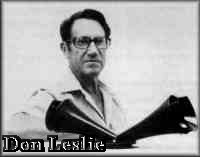
Donald J. Leslie, the man who invented the organ amplifier that bears his name, passed away last week at the age of 93.
If you like classic rock, gospel, or jazz, some of your favorite songs were most likely enhanced by a Leslie amplifier, which gave the Hammond organ its most recognized voice.
Leslie's invention was ingenious.
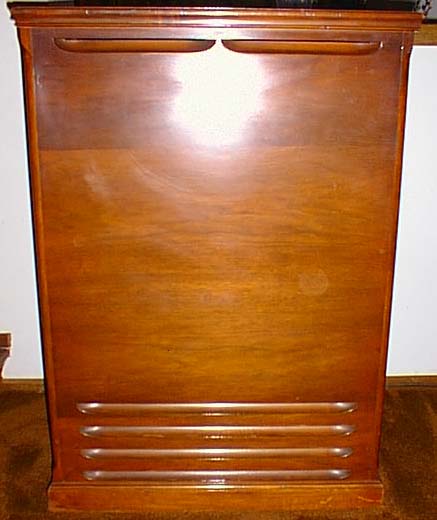
His amps typically contain a crossover that splits the audio signal, directing bass frequencies to a 15" speaker aimed down and the treble frequencies to a small driver facing up. Positioned below the bass speaker is a rotating drum (originally made out of plywood) and above the treble driver is a counterweighted horn. The drum and horn deflect the audio signal out through the louvres in the cabinet.

When set at slow speed (Chorale), the lower drum would rotate slowly and the horn not at all. But when switched to high speed (Tremolo), the top horn would rotate at up to 400 RPM. This produced the distinctive doppler-shifting vibrato that many associate with the classic Hammond sound.
I didn't know that Don Leslie was still alive as of last week, as he was not a major public figure. But as the proud owner of a Leslie 147 amp, I am thankful for his invention. You can read some of his obituaries here, here, and here. (Use Bugmenot for the registration-required sites).
Posted by: JohnL at
10:04 PM
| Comments (2)
| Add Comment
Post contains 234 words, total size 2 kb.
August 20, 2004
I have submitted the lyrics to Touch and Go by Emerson, Lake and Powell and Neil Diamond's I Am I Said.
Funny thing is, I like both of those songs.
For me lyrics are usually incidental: just a means of carrying a melody and maybe some harmony. Rarely do bad lyrics mess up good music for me, but I cannot abide good lyrics accompanied by bad (or boring) music (cases in point: Country and Rap).
The one group whose lyrics I really tune into is Rush, because they are reliably intelligent and often libertarian. Ironically, since one of the biggest turn-offs to non-Rush fans is the singer's (Geddy Lee's) voice.
Ah, well, I can't wait to see the results of the lyric contest.
Posted by: JohnL at
11:31 PM
| Comments (1)
| Add Comment
Post contains 155 words, total size 1 kb.
August 11, 2004
So it's really fun to see the tribute flowing in the opposite direction thanks to this Australian Physics Professor, who has arranged, recorded, and posted mp3 samples of Led Zeppelin's classic Stairway to Heaven as it would have been authored by Schubert, Holst, Glenn Miller, Mahler, Bizet, Beethoven, and then a grand finale mish-mash of the styles.
A loud and obnoxious "bravo" to BoingBoing for unearthing this gem.
Posted by: JohnL at
11:15 PM
| Comments (1)
| Add Comment
Post contains 129 words, total size 1 kb.

July 22, 2004
Rae at A Likely Story has compiled a long if not all-inclusive list of songs that exemplify the 80s sound. I added a couple of suggestions in comments to her list, and she's promising to extend the list soon. Check it out.
Posted by: JohnL at
10:10 PM
| Comments (2)
| Add Comment
Post contains 106 words, total size 1 kb.
June 24, 2004
Posted by: JohnL at
09:12 PM
| No Comments
| Add Comment
Post contains 31 words, total size 1 kb.
When you do something as long as Rush has and have a following as rabid, then you deliver the expected. It transcends mere concert; it is a ritual to be shared with like-minded comrades – in this case, approximately 11,000 other white guys, average age 38. You haven't seen rock devotion until you've scanned an arena filled with beefy dudes in polo shirts, their elbows darting in the air like symphony conductors, each executing his own personal session of frenzied air drumming.
Despite the family-friendly environs (for a rock concert, that is), Rush still put on a posterior-kicking show, working their way through the more than 30 years of music in their catalogue (setlist in the extended entry below). Geddy Lee, Alex Lifeson, and Neil Peart were in top form, playing an almost note-perfect show that included some nice surprises (such as a reggae ending to their pre-Peart classic, "Working Man," and a guitar solo at the end of "One Little Victory," absent from the studio version).
The visuals, while somewhat understated compared to other pop and rock acts, were effective, including lasers, smoke, pyrotechnics, and videos. Despite the gravity of many of their lyrics and their dedication to musicianship, Lee, Lifeson, and Peart always show a strong sense of humor and refuse to take themselves as seriously as their fans do. This was reflected in the humorous videos that opened and closed the show, featuring Jerry Stiller at his cranky, funny best. The Intermission video also starred bobble-head dolls in the likeness of the 70s-era Rush fighting a 3D animated dragon. My sons loved it.
There was even a nice little moment of synchronicity when Rush began to play Earthshine. When I looked up, the sky had darkened just enough that the dark side of the crescent moon was illuminated by some real earthshine. And I noticed the Jupiter - Moon conjunction, too.
more...
Posted by: JohnL at
07:51 PM
| Comments (1)
| Add Comment
Post contains 540 words, total size 4 kb.
67 queries taking 0.1107 seconds, 223 records returned.
Powered by Minx 1.1.6c-pink.

